For business owners, facility managers, and property developers in the New York area, the viability of a commercial solar project often comes down to one metric: output. How much energy does a commercial solar panel actually produce?
That number is the core of your project. It dictates how well you can offset expensive demand charges, how many panels your roof requires, and ultimately, your Return on Investment (ROI). On average, a modern commercial solar panel (typically rated 400W–600W) produces between 1.6 to 2.5 kWh per day under typical New York weather conditions.
Key Factors Influencing Commercial Solar Energy Output
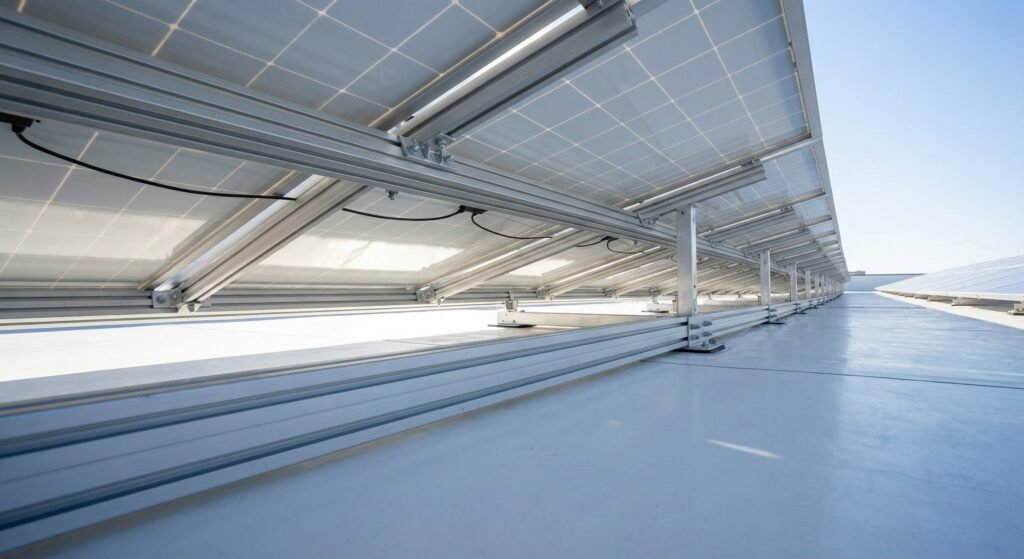
Unlike residential systems, commercial arrays must account for complex load profiles and larger surface areas. Three main factors determine your actual energy yield:
Panel Wattage and Efficiency
Commercial solar modules are larger than residential ones. While a home might use 60-cell panels, commercial rooftops often utilize 72-cell or 96-cell modules. These panels generally range from 400W to over 600W in power capacity.
| Feature | Residential Panels | Commercial Panels |
|---|---|---|
| Cell Count | 60-cell | 72-cell or 96-cell |
| Wattage | 250W – 400W | 400W – 600W+ |
| Efficiency | Standard | High Density (>20%) |
Peak Sun Hours and Insolation
A common misconception is that solar panels only work when the sun is blazing. In reality, they rely on “Peak Sun Hours”—a metric measuring the intensity of solar irradiance. According to data from the National Renewable Energy Laboratory (NREL), solar resource availability varies significantly by latitude and local climate.
- Location Context: While Arizona might get 6+ peak hours, New York averages around 4 to 4.5 peak sun hours per day annually.
- Local Data: Professional planning uses local historical weather data from Nassau and Suffolk counties to model accurate production.
Calculating the Output: The Math Behind the Power

The Commercial Solar Formula
Daily kWh = Panel Rating (kW) × Peak Sun Hours × Performance Ratio
A Real-World New York Example
Calculation for a standard 500-Watt (0.5 kW) commercial panel in Queens, NY:
- Panel Rating: 0.5 kW
- Avg. Peak Sun Hours (NY): 4.5 Hours
- Performance Ratio: 85% (Accounts for inverter and wiring loss)
The Result: 0.5 kW × 4.5 hours × 0.85 = 1.91 kWh per day
3. Maximizing Your Commercial Solar ROI
- Combat Demand Charges: Commercial utility bills are often driven by “demand charges.” A well-designed solar system reduces your peak draw during the day.
- Bifacial Technology: For white TPO or EPDM roofs, bifacial panels capture reflected light on the back of the panel, potentially increasing output by 10–20%.
- Maintenance: Regular O&M (Operations and Maintenance) is vital. Dust and urban grime can reduce output by 5-10% in metro area environments.
Why Solaroof NY Is Your Commercial Expert
Successful commercial solar requires expertise in two fields: industrial roofing and advanced photovoltaics. Industrial rooftops in Nassau, Suffolk, Queens, and Brooklyn face unique challenges from strict fire codes to complex HVAC obstructions.
Solaroof NY is different. We are experts in both commercial roofing integrity and solar energy. We ensure your roof remains watertight and your system performs for decades.
Are you ready to power your business?
Get a custom engineering analysis and ROI calculation for your commercial roof.