Ask ten homeowners how many shingles are in a bundle and you will get ten different guesses. Ask a roofer and you will usually get a question back: which shingle, and how big is the roof? That is because roofers do not buy shingles by the piece. We buy them by the bundle, plan them by the square, and the number of shingles inside the wrapper is almost beside the point.
Still, the piece count is what most people search for, so we will answer that first and then show you how to turn it into the number that actually matters, which is how many bundles to order. We install GAF shingles on Long Island, so everything below is based on GAF’s own data for Timberline HDZ, Royal Sovereign and Woodland.
Short answer: A bundle of GAF Timberline HDZ architectural shingles holds about 21 shingles, and a bundle of GAF Royal Sovereign 3-tab shingles holds about 26. Most asphalt shingles are sold three bundles to the square (100 square feet of roof), so one bundle covers about 33.3 square feet. Some specialty lines take four or five bundles per square, so check the wrapper before you order.
Want the math done for you? Use the bundle calculator at the bottom of this guide.
How Many Shingles Are in a Bundle?
There is no single number, because the count depends on the size and thickness of the shingle. GAF lists shingles per square and bundles per square for each line, and dividing one by the other tells you what is in a bundle.
| GAF shingle line | Type | Shingles per square | Bundles per square | About per bundle | Source |
|---|---|---|---|---|---|
| Timberline HDZ | Architectural | 64 | 3 | About 21 | GAF |
| Royal Sovereign | 3-tab | 79 | 3 | About 26 | GAF |
| Woodland | Specialty (shake-style) | 56 | 4 | About 14 | GAF |
Per-bundle figures are shingles per square divided by bundles per square, rounded. GAF’s environmental product declaration for Timberline HDZ lists bundles of 20 or 22 shingles.
How Many 3-Tab Shingles Are in a Bundle?
GAF lists Royal Sovereign, its 3-tab shingle, at 79 shingles per square and three bundles per square. That works out to about 26 shingles per bundle. You may see other guides quote higher counts for 3-tab, but they do not match GAF’s 79-per-square specification.
How Many Architectural Shingles Are in a Bundle?
GAF Timberline HDZ lists 64 shingles per square at three bundles per square, which is about 21 per bundle. GAF’s own declaration for HDZ puts it at bundles of 20 or 22. GAF describes architectural shingles as being made by bonding multiple layers of asphalt and fiberglass together, which is why each shingle is bigger and thicker than a 3-tab piece and fewer of them fit in a wrapper.
What About Heavy Specialty Shingles?
GAF Woodland comes four bundles to the square with 56 shingles per square, which is roughly 14 per bundle. GAF notes that some specialty shingles can take up to five bundles per square because of their added weight. Heavier shingles are packed in smaller bundles so they are easier to lift, which is why you need more of them.
Still deciding which style fits your home? Our asphalt shingle roofing page walks through the options we install.
How Many Bundles of Shingles Are in a Square?
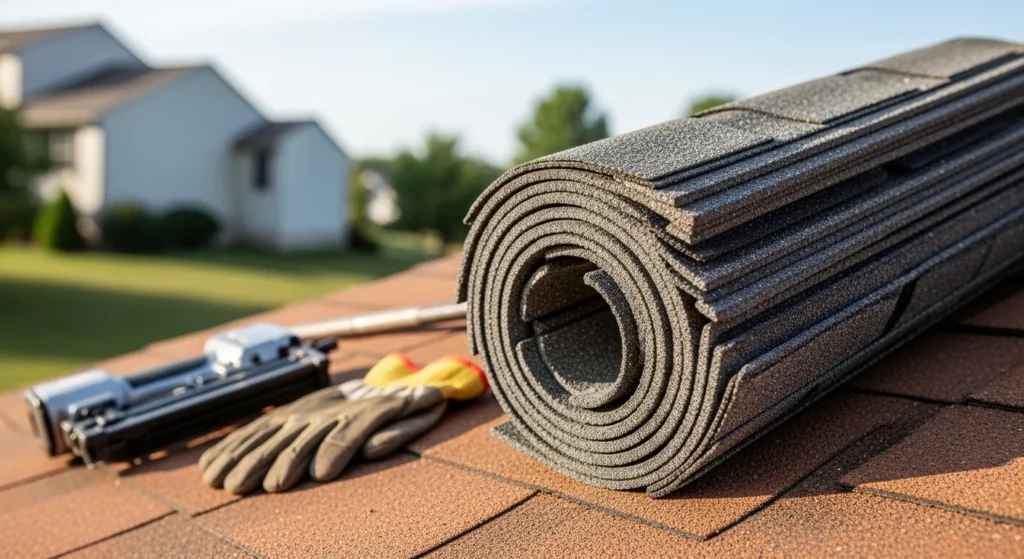
In roofing, a square is 100 square feet of roof surface, picture a patch of roof 10 feet by 10 feet. Roofers measure, order and estimate jobs by the square. GAF says most standard asphalt shingles, including both 3-tab and architectural, come three bundles to the square. GAF Timberline HDZ and Royal Sovereign are both three-bundle shingles. GAF Woodland takes four, and some specialty shingles take up to five.
That three-bundle rule is a starting point, not the finish line. GAF points out that a roof with steep slopes, rakes, valleys and dormers needs more material than the square footage alone would suggest. This is why a proper roof installation starts by measuring every roof plane instead of guessing from the floor plan.
Every bundle also carries its own label. GAF notes that all bundles are marked with their coverage area and how many are needed to cover a square, so the wrapper in your hands is the final word.
How Many Square Feet Does a Bundle of Shingles Cover?
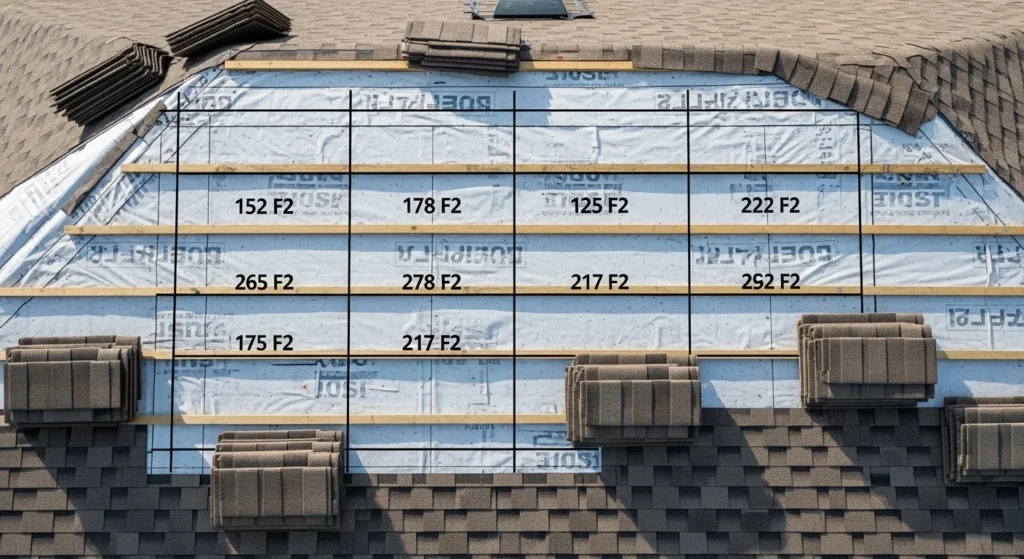
If a square is 100 square feet and a shingle takes three bundles to cover it, each bundle covers about 33.3 square feet. A four-bundle line like Woodland works out to about 25 square feet per bundle, and a five-bundle line to about 20. The more bundles per square, the less each one covers.
The formula: squares = roof area in square feet divided by 100. Bundles = squares times bundles per square, rounded up. Then add waste.
Planning a full tear-off? Here is how we approach roof replacement on Long Island.
How Much Does a Bundle of Shingles Weigh?
Weight depends on the shingle line, so the most reliable source is the label on your bundle or the product spec sheet. What GAF does explain is why bundles exist in the first place: shingles are heavy and have to be carried up to the roof, often on a ladder, so manufacturers package them in bundles that are manageable to lift. Heavier specialty shingles come in smaller bundles, which is why they take four or five bundles per square instead of three.
Weight matters on the roof too: the deck should be in good condition before any new load goes on. That is part of a proper roof inspection.
How Many Bundles of Shingles Are on a Pallet?
Pallet size depends on the product and how it ships. For GAF Timberline HDZ, GAF’s environmental product declaration says each pallet contains 52 or 36 bundles, depending on the type of shipment. Other lines can differ, so confirm the count with your supplier before delivery day.
How Many Squares Are on a Pallet?
Divide the bundles by the bundles per square. For a three-bundle shingle like Timberline HDZ, a 52-bundle pallet is about 17 squares and a 36-bundle pallet is 12 squares. For a four-bundle line, the same 52 bundles would cover only 13 squares. Same pallet, very different roof coverage.
Planning a Pallet Delivery
Before delivery day, clear the driveway or a flat spot near the house, and ask your supplier whether they can boom the pallets onto the roof. Follow the storage instructions on the wrapper until the crew is ready to use the shingles. Pallets are heavy, so avoid soft ground or a lawn you care about.
How Many Bundles of Shingles for 1,000 Square Feet?
A 1,000 square foot roof is 10 squares, so it needs 30 bundles of a three-bundle shingle before waste. GAF recommends adding 10 to 15 percent for trim allowance and waste, which puts the order at about 33 bundles for a simple roof and 35 for a more complex one. A four-bundle line needs 40 bundles for the same roof before waste.
| Roof surface area | Squares | Bundles, no waste | With 10% waste | With 15% waste |
|---|---|---|---|---|
| 1,000 sq ft | 10 | 30 | 33 | 35 |
| 1,500 sq ft | 15 | 45 | 50 | 52 |
| 2,000 sq ft | 20 | 60 | 66 | 69 |
| 2,500 sq ft | 25 | 75 | 83 | 87 |
| 3,000 sq ft | 30 | 90 | 99 | 104 |
The first three columns match GAF’s own reference table (three bundles per square, no waste). We added the 10 and 15 percent columns using GAF’s waste guidance. These are roof surface areas, not house floor areas.
How Many Bundles of Shingles for an 8×8 or 8×10 Roof?
An 8×8 roof surface is 64 square feet, just under two bundles at 33.3 square feet each. Two bundles covers it on paper, but order three if you want the waste covered. An 8×10 roof surface is 80 square feet, so three bundles covers it with room to spare. If 8×10 is the size of a shed floor, measure the roof slopes themselves first, because the roof is bigger than the floor under it.
How to Work Out How Many Bundles Your Roof Needs
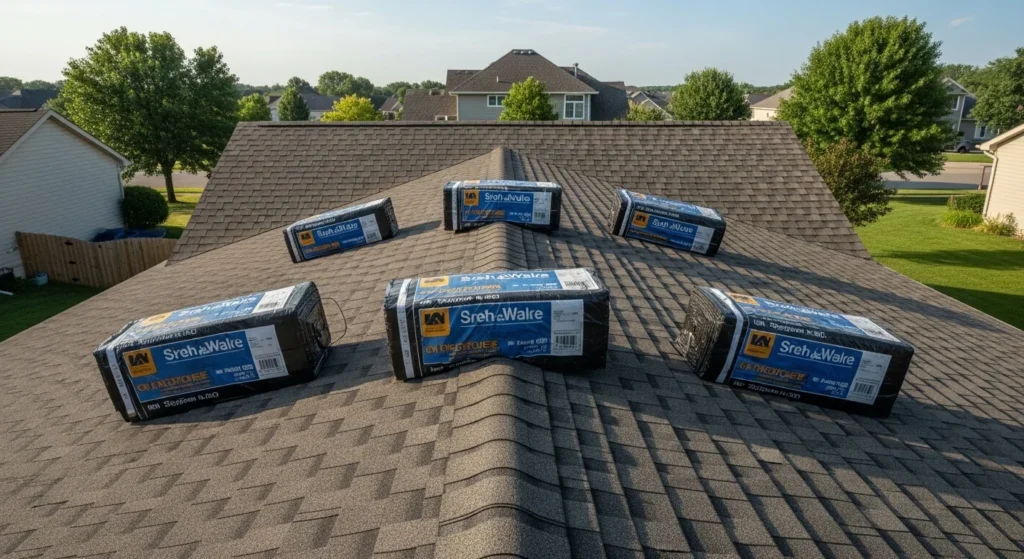
This follows the same method GAF lays out, with the extra items a roofer adds to the material list:
- Measure each roof plane. Multiply length by width for each plane, dormers included, then add them up. For example, a gable roof with two planes of 40 ft by 30 ft is 1,200 square feet per plane, or 2,400 square feet in total.
- Convert to squares. Divide by 100. That roof is 24 squares.
- Multiply by bundles per square. At three bundles per square, 24 squares is 72 bundles before waste.
- Add waste. GAF suggests 10 to 15 percent for trim allowance and waste. On that 72-bundle roof, that is roughly 79 to 83 bundles.
- Add starter strip. It runs along the eaves and rakes and is a separate product. GAF Pro-Start lists about 120 linear feet per bundle, and GAF WeatherBlocker lists 100 linear feet per bundle when the sheets are split and 50 when they are not.
- Add hip and ridge cap. Ridge cap shingles are sold separately from the field shingles, and each bundle states its coverage in linear feet on the label.
GAF treats a roof as a system, not just shingles: starter strip, roof deck protection, a leak barrier, ridge cap and attic ventilation all go with the shingles. Make sure your material list covers them.
Does Roof Pitch Change the Bundle Count?
Yes. A steeper roof has more surface than a flatter roof over the same footprint, which is why GAF warns that your roof size will not equal your home’s footprint. If you can only get the footprint, multiply it by the pitch factor to estimate the roof surface.
| Pitch (rise per 12 inches) | Pitch factor | 1,000 sq ft footprint becomes |
|---|---|---|
| 4/12 | 1.054 | About 1,054 sq ft |
| 6/12 | 1.118 | About 1,118 sq ft |
| 8/12 | 1.202 | About 1,202 sq ft |
| 10/12 | 1.302 | About 1,302 sq ft |
| 12/12 | 1.414 | About 1,414 sq ft |
Pitch factor is the square root of 1 plus (rise divided by 12) squared. Overhangs add a little more roof area.
Here is a worked example. A 1,000 square foot footprint at a 6/12 pitch is about 1,118 square feet of roof, or 11.2 squares. At three bundles per square that is 34 bundles before waste, and about 37 with 10 percent waste.
Waste Factor: 10 or 15 Percent?
For a simple gable roof with few penetrations, 10 percent is the usual starting point. For hips, valleys, dormers, skylights and chimneys, plan toward 15 percent. Extra bundles also give you a few spares for future repairs, which is handy if the exact color is ever hard to find.
Common Mistakes When Ordering Shingles
- Measuring the floor plan. Pitch, overhangs and dormers all add roof area that the floor plan does not show.
- Counting shingles instead of coverage. Piece counts change by product line, but a three-bundle shingle always works out to about 33 square feet per bundle.
- Ordering with no waste. A job that stalls halfway because the pallet ran short leaves the roof open to the weather.
- Forgetting starter and ridge cap. They are separate products with their own bundle counts.
- Assuming every line is three bundles per square. Check the wrapper, especially with specialty lines.
Not sure about your measurements? Ask us to measure your roof and we will give you a clear number.
3 Tab vs Architectural Shingles: What Changes for Your Order?
For ordering, very little. Both GAF examples are three bundles per square. What changes is what is inside the wrapper, and how the shingle is built. Architectural shingles are made from multiple bonded layers and have a distinct three-dimensional look, while 3-tab shingles have a flatter, more uniform look. GAF describes architectural shingles as stronger and more durable than 3-tab.
| GAF Royal Sovereign (3-tab) | GAF Timberline HDZ (architectural) | |
|---|---|---|
| Shingles per square | 79 | 64 |
| Bundles per square | 3 | 3 |
| About per bundle | 26 | 21 |
| Nails per square | 316 | 256 |
| Construction | Flat, three-tab look | Multiple bonded layers, dimensional look |
Source: GAF product specifications for each line.
Can You Do This Yourself, or Should a Roofer Measure?
A small shed or a patch repair is a reasonable do-it-yourself order. A full house roof is a different job. It involves tear-off, deck repair, underlayment, flashing, ventilation and following the manufacturer’s installation instructions. GAF itself recommends taking precise measurements or hiring a roofing contractor so everything is installed correctly. If you are unsure about your measurements or the condition of the roof, have a roofer look at it before you order a single bundle.
Signs It May Be Time to Replace, Not Repair
- Shingles that are curling, cupping or cracking across large areas
- Bare patches, or lots of granules collecting in the gutters
- Leaks that keep coming back after repairs
- Missing shingles in more than one area after a storm
If one spot is the problem, roof repair may be all you need. If water is coming in right now, see our emergency roofing services.
Planning a Shingle Roof on Long Island?
Solaroof NY has been serving Long Island since 1998, and we install GAF shingles. If you are weighing a new shingle roof, we will measure your roof, confirm the shingle line and how many bundles it takes per square, and give you a free quote. You can read more about asphalt shingle roofing, our roof installation process and roof replacement on Long Island, or browse all of our roofing services.
Get a Free Roofing Quote
Tell us about your roof and we will take the guesswork out of the numbers.