When business owners explore commercial solar, the first questions are usually about the financial return and the time commitment. Commercial solar adoption is accelerating nationwide as companies look to lock in long term energy independence. According to the U.S. Department of Energy, the efficiency of the installation process has improved, yet the administrative phases remain the most critical part of the schedule.
Typical Commercial Solar Project Phases and Durations
A standard commercial project in New York typically takes between 3 and 8 months from initial assessment to full operation. While the physical work on your roof might only take a few weeks, the engineering and permitting phases account for the majority of the schedule. Below is a breakdown of the standard timeline for a 100kW rooftop system.
| Project Phase | Estimated Duration | Core Activities |
|---|---|---|
| Site Feasibility | 1 to 2 Weeks | Energy audit and roof inspection |
| Engineering Design | 2 to 4 Weeks | Structural review and layout design |
| Permitting Approvals | 4 to 12 Weeks | Building permits and utility interconnection |
| Physical Installation | 1 to 5 Weeks | Panel mounting and electrical wiring |
| Utility Interconnection | 2 to 4 Weeks | Final inspection and Permission to Operate |
Variables Affecting Your Solar Transition Speed
Two buildings of the same size can have different timelines based on external factors. A new and structurally sound roof allows the project to move immediately into engineering. However, if repairs are needed, those timelines stack. Additionally, projects under 200kW typically bypass the more complex utility studies required for massive multi building campus installations, leading to a faster Permission to Operate (PTO).
Assessing Commercial Property Solar Potential
Before permitting becomes relevant, you must understand how much solar your property can support. South facing roof sections produce the most energy in New York, but east and west facing sections are often economically viable. The goal is to match generation to your consumption patterns. In 2026, New York remains a top tier solar resource with high electricity rates that significantly improve the payback period for local businesses.
Technical Foundation of Site Assessments
A thorough site assessment prevents mid project surprises. Professional evaluations cover roof remaining useful life, structural load capacity for racking, and electrical infrastructure readiness. By identifying whether your switchgear needs an upgrade during the feasibility phase, you can order equipment in parallel with permitting to avoid dead time during the construction phase.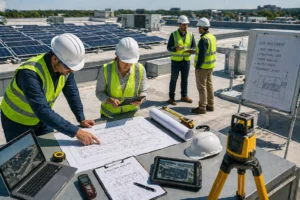
Professional Project Management for Efficient Delivery
Delays in commercial solar often happen in the coordination gaps between engineers, permit offices, and utilities. Effective project management means owning each handoff. Working with a dedicated project coordinator ensures that permit applications are tracked proactively and equipment procurement is managed to match installation readiness. This streamlined approach minimizes the total time from contract to savings.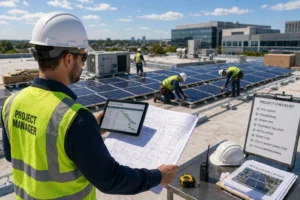
Moving From Final Inspection to Operational Savings
The final weeks of a project involve passing local code inspections and receiving written authorization from your utility. Once Permission to Operate is granted, your system begins offsetting your utility bills immediately. For a large commercial system, this can translate to thousands of dollars in monthly electricity cost avoidance. Starting this process today ensures you lock in current incentives and begin your ROI journey as soon as possible.
Financial Incentives for New York Commercial Solar
New York businesses currently benefit from a 30% Federal Investment Tax Credit (ITC) under the Inflation Reduction Act. When combined with NYSERDA NY Sun rebates and accelerated depreciation, the financial case is incredibly strong. These incentives effectively lower the upfront investment while the high energy rates in Con Edison and PSEG Long Island territories accelerate your break even point.
Conclusion
While the physical work on your roof is quick, the full administrative journey requires careful planning. Most New York commercial properties will complete their transition within 3 to 8 months. By engaging an experienced team for your site assessment and project management, you ensure a smooth process that delivers long term value. The best time to start your feasibility study is now to ensure your system is operational for the peak sun season.
Request Your Commercial Site Assessment
Ready to see the real timeline and savings for your building? Let our experts provide a custom feasibility study.